For dermatology and aesthetic practices
We bring scanner and consultation software. You treat.
You get the 3D skin scanner and the Dermalia consultation software together, with no purchase price. Every capture becomes a branded skin report, a treatment plan from your own catalogue, and the follow-up appointment. If an Isemeco device is already in your practice, we connect it.
Integration
Fits your current workflow.
We connect to the scanner backend automatically, pull the raw data and build the report. Your assistants don't need to learn anything new.
Scan as usual
Your patient takes a seat at the Isemeco device. Capture as always. The device displays a QR code at the end.
QR into the web app
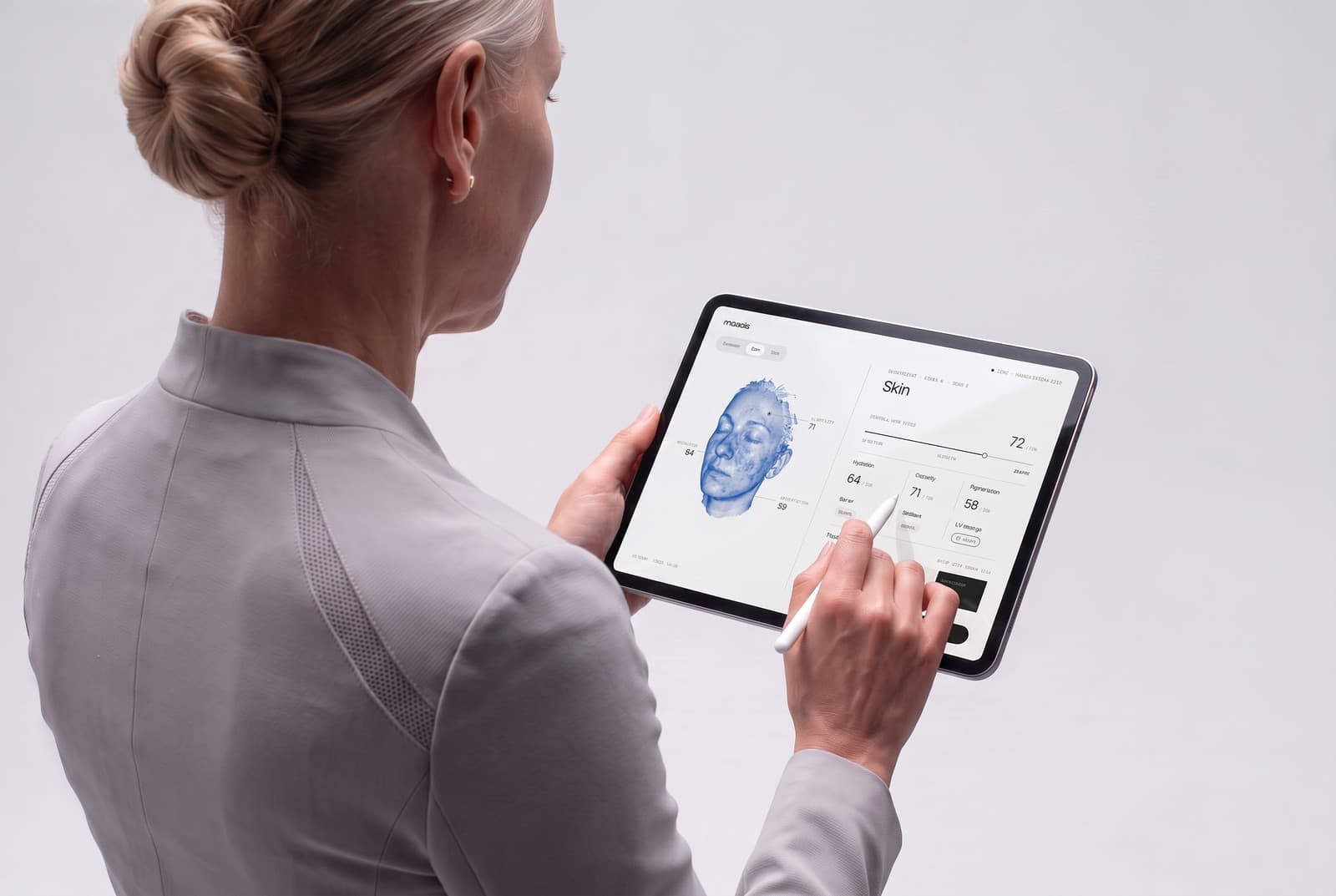
Your assistant holds the tablet with the Dermalia web app to the screen. Optionally enter first name and email. Done.
Report, plan and follow-up
We pull the scan data and build the report. During the consultation you assemble the treatment plan from your catalogue, the patient receives both by link, and the next appointment is set before she leaves.
What's in it for your practice
More to discuss.
Less to explain.
Patients actually read the report
Not a data sheet but a designed report. Patients arrive prepared for the follow-up appointment.
Your brand on top, not ours
Practice logo, practice name, practice contact details. Dermalia sits small in the footer as the tech provider.
Before/after tracking
From the second scan of the same patient on, the report shows the change on every score axis. Clean ground for the follow-up conversation.
Practice recommendations you control
Treatments and ingredients are maintained by you in the dashboard. You decide which recommendation matches which finding tag.
Allow report questions
Optional: patients can ask questions about the report. Answers stay clinical, no diagnoses, no therapy suggestions.
No marketing to your patients
We don't sell treatments, no cosmetics, no products. The follow-up conversations stay in your practice.
GDPR and MPDG compliant
Servers in Germany, data processing agreement, clear retention periods. Details at /sicherheit.
Your own report URL
On request reports run on your own subdomain (e.g. report.yourpractice.com).
Fast pilot
Onboarding in 30 minutes. You'll see the first reports the same day.
Frequently asked questions
What practices want to know before software onboarding.
Which scanners are currently supported?
Isemeco D8 and D9. Other vendors (Canfield VISIA, Sylton Observ, Miravex Antera 3D) are technically possible, but the report modules are built around the Isemeco 3D mesh and spectra. A VISIA integration drops the 3D-specific modules (rotatable model, contour analysis). If you run a different device, get in touch and we'll work the use case through.
How fast is onboarding?
Onboarding conversation and practice configuration run in a single session, around 30 minutes. The first reports can be produced the same day. Assistant training typically takes 30 to 60 minutes and is included.
Do we have to migrate existing patient data?
No. Dermalia starts with the first scan after onboarding. Older captures in the Isemeco backend can be imported retroactively on request, but this is not required. Patient master data lands per scan; the practice keeps control over what is handed to Dermalia.
Can we try the software before committing?
A full sample report sits publicly at /analyse/beispiel. In the onboarding call we additionally walk you through how branding, modules, thresholds and the recommendation catalogue are configured. Pilot practices use the workflow free of charge for three months.
Who has access to the report data?
Practice team via the dashboard (role-based: Owner, Admin, Member). Patients via the report link they receive by email. Dermalia staff only access for support or maintenance, every access is logged in the audit log. Detail terms in the data-processing agreement at /sicherheit/auftragsverarbeitung.
What happens on cancellation?
You receive a complete export of all report data as JSON (Art. 20 GDPR, machine-readable). On request additionally as a PDF archive per report. Then your practice organisation is deleted on our side, including blob assets and backup traces. This commitment is in the data-processing agreement.
Who carries GDPR responsibility?
The practice is the data controller (Art. 4(7) GDPR), Dermalia is the data processor (Art. 28 GDPR). We provide our DPIA template and the patient consent template to integrate into your own documentation. For larger practices we recommend coordination with your data protection officer.
Integration with our PVS or KIS?
Dermalia currently runs as a standalone report layer alongside the PVS, without an automatic GDT handover. A GDT interface for common systems is on the roadmap; concrete timing we share in the onboarding call, depending on your PVS.
Read more
If you want to go deeper.
Three articles answering common practice questions with concrete sources.
GDPR for 3D skin analysis, practice checklist
Processing record, data-processing agreement with us, US and China sub-processors, DPIA.
Open article →3D topography vs 2D multispectral
Where the report difference actually sits, in four sections, with manufacturer sources.
Open article →Skin analysis in the anti-aging practice
Which report blocks carry weight in aesthetic consultations and which should be hidden.
Open article →Devices and methods
- Skin analysis devices for practices, the 2026 comparisonVISIA, Observ and Isemeco end up on the same shortlist in most purchasing decisions. This guide sorts the three systems along the questions a practice actually has to settle first: measuring method, budget range, billing, data protection and floor space.
- Procuring a skin scanner for your practice, decision guideFive questions come up before buying a 3D skin scanner that many practices only clarify afterwards. We walk through them in order: room, power, staff training, MDR classification and ROI over three years.
- VISIA vs Isemeco, an honest comparisonCanfield VISIA has been the most common skin analysis system in dermatology practices for over twenty years. Isemeco D8/D9 is the younger 3D generation. We compare both devices on the points that actually decide a purchase: methodology, report depth, cloud hosting, service and price.
- Observ vs Isemeco, when each device makes senseSylton Observ 520x is a compact multispectral device used by many cosmetic clinics and some dermatology practices. Isemeco D8/D9 are 3D topography systems from the medical segment. We show where the two overlap and where they part ways.
- Isemeco D8 or D9, which skin scanner fits which practiceThe Chinese manufacturer Meicet ships two current device classes into the EU market: the compact Isemeco D8 and the larger floor-standing D9. We compare optics, patient throughput, room requirements and total cost of ownership, soberly, without vendor marketing.
- 3D skin analysis vs 2D multispectral, where the difference really liesVISIA, Antera 3D, Observ, Isemeco, imaging methods in skin analysis differ in more than marketing. We compare 2D multispectral (VISIA) and 3D topography (Antera, Isemeco) along the four report areas where the methods diverge in practice.
Billing and rollout
- Billing skin analysis, which GOÄ code applies whenDigital 3D skin analysis has no native code in the German fee schedule (GOÄ). We walk through the three codes practices actually use today, including multipliers, analogous billing per § 6 (2), and what you must declare as a self-pay service for statutory-insured patients.
- Introducing a skin-analysis IGeL service in your practice, from consent to billing3D skin analysis is a classic German IGeL (Individuelle Gesundheitsleistung). We walk through the steps the German federal medical organisations (KBV and BÄK) define for a clean IGeL introduction, from patient briefing through the written agreement to billing, and show where Dermalia fits into each step.
- Procuring a skin scanner for your practice, decision guideFive questions come up before buying a 3D skin scanner that many practices only clarify afterwards. We walk through them in order: room, power, staff training, MDR classification and ROI over three years.
Law and data protection
- GDPR for medical image analysis, a practice checklistWhen you use 3D skin analysis in your practice, you are processing health data under Art. 9 GDPR. What does that mean concretely? We walk through the eight points a practice must clear before the first real patient scan, legal basis, data processing agreement, information sheet, retention and the third-country transfer problem.
- Patient consent for 3D skin analysis, what Art. 9 GDPR concretely requiresBiometric facial scans are special categories of personal data under Art. 9 GDPR. We walk through which legal bases are available, what the consent must contain, and where the most important traps for the dermatology practice sit. Not a template, a requirements checklist.
- MDR classification for skin-analysis software, what MDCG 2019-11 means for the practiceIn June 2025 the Medical Device Coordination Group (MDCG) published MDCG 2019-11 Rev.1 and tightened the rules on software classification under MDR and IVDR. We walk through what this concretely means for software around skin-analysis devices, where the class boundaries sit and what practices should check before deploying.
- Skin analysis without AI diagnosis, why the line mattersMore and more skin scanners advertise automatic assessment and suspected diagnoses. Dermatological associations warn against it. This piece explains the line between measurement and medical judgement, and why a report that respects it is the safer choice for a practice.
- GDT interface for skin-analysis reports, how the integration with your practice software worksGDT is the established German standard for transmitting device data into practice management systems. We walk through what the current GDT 3.5 version delivers, how the integration of skin-analysis software with your PVS looks technically, which data records are relevant, and where Dermalia stands today.
Indications in consultation
- Skin analysis in the acne consultation, what the UV capture actually showsPorphyrins, pore counts and longitudinal documentation during isotretinoin therapy. We walk through the typical acne report workflow: what a 3D skin analysis shows, what it does not, and where the limits for diagnosis and advertising sit.
- Skin analysis for rosacea, what erythema mapping and telangiectasia findings deliverRosacea is a chronic, relapsing-remitting indication whose course is hard to document in words. We show how 3D skin analysis with the redness spectrum helps with erythema and telangiectasia, what role IPL and pulsed-dye laser play in the current therapy mix, and where the limits for advertising and diagnostic claims sit.
- Skin analysis for pigment disorders and melasma, separating UV from visible pigmentMelasma, solar lentigo and post-inflammatory hyperpigmentation look clinically similar but sit at different depths in the skin. We show what the 3D skin analysis contributes to the differential workup, how the Modified MASI score can be used as a longitudinal metric, and where the limits for advertising sit.
- Skin analysis in the anti-aging practice, what patients should actually seeA skin analysis is not mandatory in the aesthetic consultation, but when it is used, the format decides patient retention. We show which report building blocks really carry weight in an anti-aging practice and where device marketing misses the point.
- Fitzpatrick skin type and Individual Typology Angle, why laser practices need bothFitzpatrick skin type I-VI has been the standard for laser-energy selection for decades. The Individual Typology Angle (ITA°) provides an objective device-based complement in the CIELAB colour space. We walk through what each scale delivers, where they differ, and how a practice uses them together for safe laser preparation.
- Skin analysis and skin cancer prevention, why 3D topography is not a screening substituteA cosmetic 3D skin analysis detects UV pigment, wrinkles and pores. It does not detect melanoma and does not replace dermatoscopy or statutory skin-cancer screening. This article makes the methodological limit explicit, describes where the method legitimately complements the prevention chain, and names the regulatory background.
- Before/after with skin analysis, what makes treatment documentation reliableA before photo and an after photo are not enough. Anyone documenting filler, botox, microneedling or laser therapies needs reproducible captures, normalised positioning and comparable score values. We walk through the five requirements a skin analysis must meet for honest before/after.
Pilot programme
Five practices get device and software provided.
We are looking for five dermatology and aesthetic practices to start with in Germany. You do not need your own device: we bring the scanner, set it up and train your team. You pay out of usage, not up front.
- No purchase price, no advance payment
- Setup, team training, data protection documents
- Direct line to our founding team
- Billed per analysis, you only pay for what you use
Request a demo
We show it in your practice.
Two details are enough. You get an immediate confirmation with the terms, then we come back to you about the date.